Sunday, March 31, 2019

The Great Texas Road Trip Thank-You Tour: 18. It's a Rainy Night in Denton

Writing for me has always been an associative process.  I sit down with a single image, thought, or feeling, and then rummage through the equivalent of old magazines in my mind, ripping out bits and pieces, like a collage artist.  Then, I assemble them bit by bit, hoping they'll lead to some sort of semblance.  Perhaps this sometimes leads to layers and complexity that wouldn't develop if I worked more linearly.   Perhaps sometimes it just leads to multiple journeys down off-topic paths that don't add to the overall effect and only contribute to wordiness.  I always hope it's not the latter.  I want something that shimmers like the world through a rain-dappled window at night--blues, yellows, reds and purples pocked and streaked in sub-narratives that mix and mingle and diverge again.  What I really want my writing to do is dazzle.  If pushed, I'd probably have to say, I'm for style over substance.  I don't mean any particular style.  I just mean sound.  Visual sound.  Auditory sound.  The power of words as words.  Sure, I'd like to say something worthwhile in the process.  But, the truth is, I write to write.  To reach into that cool deep well and pull out some slick, dripping image, and to hear that translucent sound layered up, as I stack image after image.

I was first aware of the power of words as simply words, when as a teenager, I heard Bernie Taupin's opening lyrics to Elton John's "We All Fall in Love Sometimes":


Wise men say
It looks like rain today
It crackled on the speakers
And trickled down the sleepy subway trains
For heavy eyes could hardly hold us
Aching legs that often told us
It's all worth it
We all fall in love sometimes. (John)

Wow.  The sounds.  "Wise men say."  Stop.  "It looks like rain today."  The movement.  From the abstract--"Wise men say  / It looks like rain today"--to the hyper-concrete, if not surreal:  "It crackled on the speakers."   You get a popping image.  A cracking sound.  A ping.  Something short and quick.  Then you slide into the slick, watery image of  "And trickled down the sleepy subway trains."  Oh how that rain mingles with the chrome and stainless steel of the subway train.  Then you return to dead weight.   "For heavy eyes could hardly hold us"  Whose eyes?  Why?  And then that weight is given tactile reality.  "Aching legs often told us."  It was so serenely beautiful, in an achingly heavy sort of way, like failed love.

I didn't realize it at the time, but that is the moment I became a poet, a worshiper of words and their power to elicit and communicate that which is beyond everyday language.  I realized that day looking out the rain-specked sliding-glass door of my dad's house in Reno on a cold day at the end of May, clouds hanging low on Peavine Peak, that words in reality are instruments, and one could play them in different ways, creating different moods and tones, perhaps even layering them up like a symphony, depending on how you used them.

And so I wish to open this number with a borrowed note, a heavy but steady feeling, of longing, of yearning--a subconscious water that bubbles up rich and black, full of bits of decayed wood and other organic shit.  Life-strong.  Felt, but not easily described.

It comes from a song.  "A Rainy Night in Georgia" by Brook Benton.  It starts off so slow.  A gentle mist.  Slick streets.  Heat and heavy humid skies.  Then the steady beat of a heavy downpour, neon lights streaked and swirled in street gutters, water everywhere, mixed with light, going great guns.

Only this is a rainy night in Decatur, Texas.  I'm driving.  The wipers are going.  Going and going.  They must be worn out, for they leave a heavy streak behind.  I can't see where I'm going.  I can't drive at night under the best of conditions.  I broke my glasses and haven't replaced them.  At some point, we pull over, and Marci takes over.  We're headed east on U.S. 380 toward Denton.  This is now familiar territory, heavy with history.


Writing is tricky business.  We live so much of our lives leaving out the hard parts.  We just get through them instead.  We ignore the layers: how the happiness is mixed with pain.   How the now bleeds into the past.

Writing, good writing, the type worth composing, the type worth remembering, drips density like heavy Spanish moss on a soggy southern night.  In good writing, you can't thank someone without being honest, and you can't be honest without digging in the muck.  You've got to get at the slick, torn, layers of magazines you pull from the mud and glue to the canvass.  It's an exaggerated process, hyper-focused on a moment or feeling.  And for some reason, it works better if the images haven't been accessed for a long time.

In a writer's life, he may be 100% committed to now:  his current marriage, his children, his work--simply all that matters to him in the present.  Yet, the good writing is still deeply connected to his past.  It has to be.  There is something about the story getting buried in the subconscious and stewing down there with other stories, other images, and then bubbling up to the surface.  Time is the essential ingredient.  The image must be removed in space and time from today.

Therefore, when a writer writes, he lives in the past.  At that moment, past loves, past heartaches, past encounters with food, sunlight, an ant crawling over some broken glass in a crumbly crack in a sidewalk--they all take on more significance than anything current.  It's not that the past was better, just that it was buried--mucked up and distorted by the mind seeking to make semblance.  Creative writers, unlike so much of the population, are keenly aware how inaccurate memory is and how personal everyone's story is, even between people witnessing the same events.  We don't mind.  In fact, we thrive on it.  It is a feeling we're after, like a jazz musician.  We're not after historical accuracy, nor a propaganda-slant.  The aim is simply to transfer an honest emotion to the reader produced by a given set of images at that moment.  In another moment, we may look at the same set of images, and come up with something completely different.

So, if you marry a writer, be prepared to live with their past loves--at least in their writing.  It's not that your spouse is constantly thinking about old flings.  It's just that is where the material is.  If it makes it easier, know that when your spouse is writing, he or she is also spending a lot of time watching condensation bead on a cold Pepsi on a hot summer's day or noticing the pearly black-green head of a fly as it lands on a fresh dog turd.  It's not a particular part of the buried past that we're after.  It's all of it.  Old loves just happen to be part that.

Anyway, in this story  Marci is driving.  I am next to her.  That's how it should be.  I have two lives--one where despite the good people around me, I was astonishingly unhappy.  And the current one, where I am generally a happy man.  As much as I alter both the past and present in my writing to suit my artistic purpose, that fact is unequivocally unalterable.  There is a before.  There is an after.   Meeting Marci is that pivot point.  She is that fulcrum between sorrow and joy.  But she wasn't my first love, nor my second, nor my third, and she wasn't who I was thinking about on that rainy night between Decatur and Denton.  How could she be?  This was my terrain, not hers.

And so, as Marci dealt with the rain, I dealt with memories of an old friend who at the time I desperately wanted to be more than just my friend.  I was in love.  Or at least I thought I was.  I'm not sure now.  Can desperation ever truly be love?  Probably not.  By the time I met Marci, I had been through enough, that I was finally willing to deal with me, and know who I was.  That made love a little easier.  But if desire isn't love, I at least definitely desired.  And it was a one-way street.

Here's where it gets messy.  The girl was Andrea.  She is now married to Marsh, one of my best friends, as is she.  This blog, which I hope will someday be a book, is meant as a series of Thank-You postcards sent out to those who shaped my life in Texas.

Marsh is still my good friend.  Other than as a friend, I no longer have any feelings for Andrea.  When they got married, I was happy for them, even though my own life at the time was a mess.  My trouble had more to do with my relationship with God than it had to do with any human relationship gone bad and even then I held no hard feelings towards Andrea.  Now, after finding Marci, as well as finding my way back to God,  I feel nothing but warmth for the two of them. But, I get the sense Andrea avoids me.  Perhaps she feels guilt, perhaps she thinks she hurt me.  She did, but it was unavoidable.  Perhaps she wonders why one day I just disappeared--a friendship, temporarily, evaporated.  All I've got in my defense is self-survival.  Perhaps, she doesn't think about it all.  If she feels any guilt, she shouldn't.  She did what she had to do.  I did what I had to do.  What remains is that we were good friends.

It was her I was thinking about while looking out at the slick, black Texas landscape, lightning flashing on the horizon.

It made me think of another night, long ago, at Drop Creek.

That too was a rainy night.  Heat and steam.  Big, black swaying trees down by the creek.  The slow trickle of water over the concrete where the road formed a dam.  Behind it was a swimming hole.  We skipped stones and she told me about going skinny dipping with a guy.  Perhaps she told me this.  The mind has its way of creating its own narratives.  There was a rope swing.   I remember feeling longing, feeling jealousy.

North Central Texas is a place in my mind between Denton and Decatur.  I seldom think about it now, but when I do, it usually involves two lonely people driving around in a maroon Plymouth Reliant without air-conditioning.  One is running from a breakup with her boyfriend.  The other is hoping to be loved by somebody, anybody, and noticing the girl sitting beside him isn't bad looking, decides to fall in love.  She has wonderful, warm eyes and cute dimples when she laughs.  She has a cute, little laugh that she half-stifles.   She likes to sing in empty grain silos.  One day we stop the car in the middle of a long, straight dirt road, as a tarantula crosses. We get out and look at it.  She likes Drop Creek, as do I.  We go there sometimes.  I'm lonely and she doesn't have anything to do back at her apartment other than to put on her ice skates and slide across the linoleum floor of the small kitchen and dream of winter in Minnesota and simpler times.   She has her own stories there, just like she has her own stories at Drop Creek, at clubs, at stadiums.  They always involve other guys.  Usually Jim, also my friend.  I don't like her stories much, not because they're not good, but because they don't involve me.  She shares them with me anyway, and I listen because I'm lonely and Drop Creek is always beautiful: that big, leafy green tree; that rope swing;  the deep green water, with bugs skimming the surface in the early morning sunlight.   Heat, humidity, electricity.  Alright, it's true, I was in love.  Young love--the type that never asks why.  The type of love more concerned about the self than the other.  But, it is, without question, love.

One morning, in Dallas, after she's moved in with her mom, I pick her up to go to Denny's for breakfast.  We're in the car, driving down Mockingbird Lane, sunlight bouncing off the back windows of the line of cars in front, the concrete as glossy as a river.  It must have been winter.  There was a tiny bit of melting frost on the pansies at her mother's house when I picked her up. Anyway, she tells me she had a dream.  She says Marsh was in it.  She says she saw his feet in the dream.  That was it.  The dream was over.  She says she noticed how beautiful his feet are.  That's all she says, but I know then, that unlike us, the two of them will someday be more than friends.  The good person in me wants to tell her what her dream is telling her.  The bad person in me doesn't.  I let the bad person take over.  Not that it matters.  Everyone knows their own dreams.  She found her way to him eventually.  But, perhaps she might have found her way to him sooner had I said something.  Perhaps it is me who should apologize.  She had some hard living after I vanished.

Writing this now, I hear another song.  "Sweet Melissa" by the Allman Brothers.  I'm not sure why.  But I'm sure it's there for a reason.  Black waters bubble rich, full-bodied.

So, here's my first official Great Texas Road-Trip Thank-You.  I send it out to Andrea.  I'll send Marsh his later.

It's not clean.  There's muck and dark matter all over it.  There usually is.  Life is complete, which means it's complex.  But it's also sweet.  Andrea, thanks for the drives around North Central Texas.  I'm glad both our lives sucked enough we didn't have anything better to do than drive around and look at grain silos.  Marsh, I hope you understand.  You are the man, and Andrea could not have ended up with anyone better.  To both of you, and your children, and their children.  Friends always, into the eternities.


References

John, Elton. "We All Fall in Love Sometimes." Captain Fantastic and the Little Dirt Brown Cowboys. By Elton John and Bernie Taupin. LP, 1975.


Saturday, March 30, 2019

The Great Texas Road Trip Thank-You Tour: 17: Beans at a Dairy Queen in Bowie, Texas


Travel Date:  September 10, 2018

Yesterday, thinking back on the heat and the trip, I was wondering how it could have been close to sundown when we decided to get off of 287 at Bowie in search of a Dairy Queen we saw advertised on a billboard.  Then, I remembered it was September and days were shorter.  Oh, how long have I been away from Texas!  I associate warm evenings with summer, and therefore long days.  So wrong my friend, so wrong.  Heat in Texas is a ten month affair.  Ride 'em cowboy, ride 'em cowboy--don't let that heat get you down.

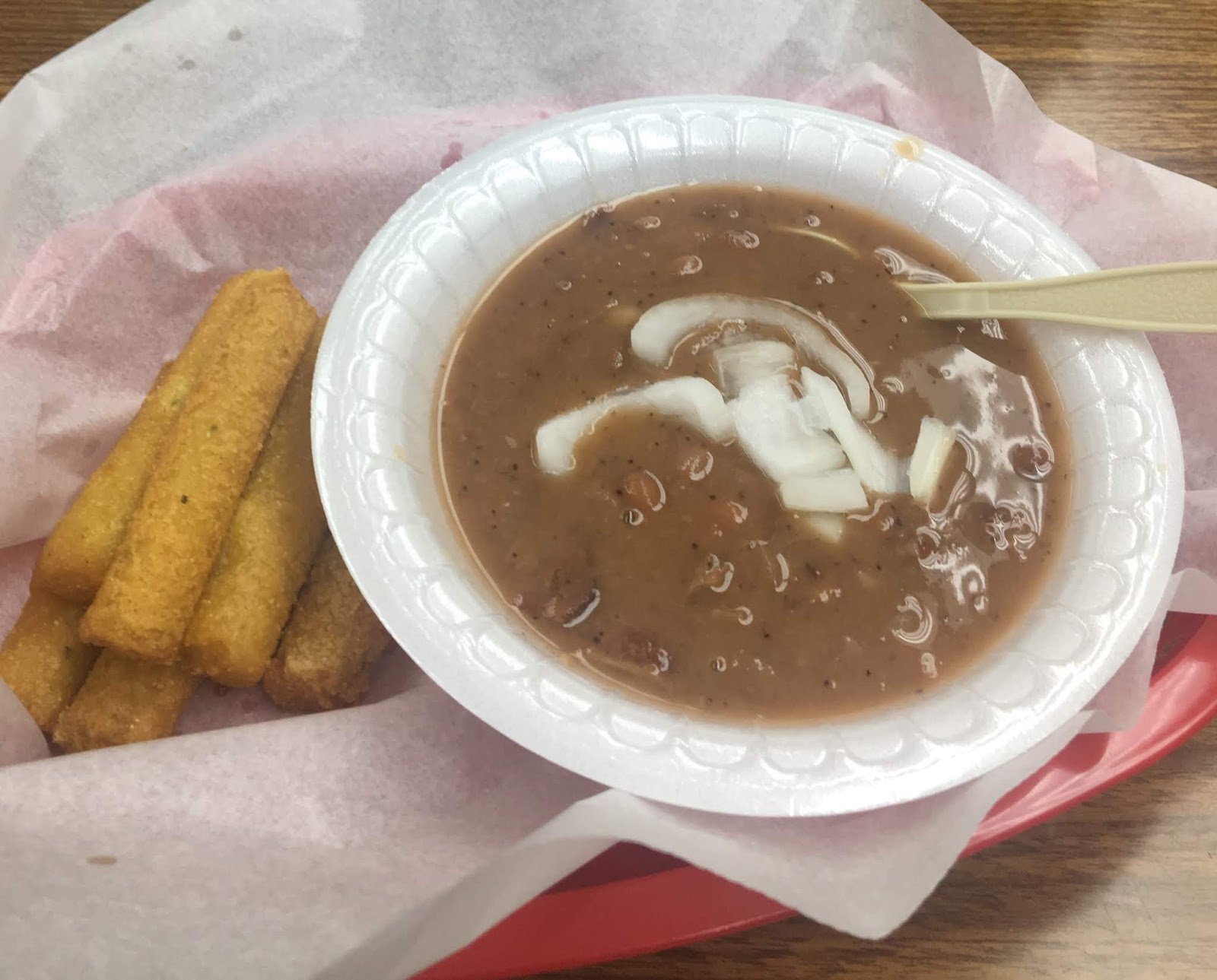
I don't know why I threw in that last sentence.  It just sounded right.  In Bowie we experienced beans at Dairy Queen.  Perhaps it is because of that.  Marci stood in front of the counter as if the floor had dropped out from under her and a surreal universe opened below her feet, and then spread up around her, as she floated in a star-speckled sky with cartoon symbols of Texas floating around her in bright neon.  There goes a neon blue blue cowboy riding an neon orange bull.  There goes a red neon shape of the great state itself.  There goes a neon pink cowgirl in Daisy Dukes riding a purple bronco--all swirling in and around Marci like a Texas tornado: stars, galaxies--there goes Jupiter!--oil pumps, refineries, bank towers.  I believe that was Ted Cruise that went swirling by just now, smiling like a jackass.  

Through this hazy, Texas-styled psychedelic experience came a deep woman's voice thick with southern drawl:  "Yes Ma'am, beans are our special tonight!"

Marci stood stunned.  Then, finally stuttered, "B-b-b Beans in a Dairy Queen?"

"Yes Ma'am, they's come with hush puppies too."

I stepped in to translate.  "That sounds good, we'll take two."

"Do you dip the hush puppies in the beans?" asked Marci, trying to get a grip on this new universe she instantly founder herself floating around in like Major Tom.

"Well, Ma'am," said the girl, "You can do whatever you like with them there hush puppies."

I stepped in, again, this time more to negotiate a peace treaty rather than to translate.  "That sounds good, we'll take two orders."

We were handed two Styrofoam bowls and pointed towards the bean bar.  "You'll find all the fix'ns there" she said with all that Texas niceness even as she slipped a noose around Marci's neck with her wide, all-encompassing smile. "I'll bring the hush puppies out to ya'll."   I heard that old Pace picante sauce commercial playing in my head:  "Get a rope."

I soon calmed down though.  Those beans topped with onions were oh so warm and comforting.  If I ever find myself on death row in Texas, which statistically speaking isn't that difficult, I think I'll request a bowl of beans as my last meal.  Oh so comforting.  I could tell even Marci enjoyed them.  To this day, she carries a photo around in her iPhone along with pictures of our children and pets.  "And here," she'll say, proudly, "This is where we had beans at DQ."  She never adds, "imagine that!" because that is not her type of phrase.  But I always hear it, because her voice carries that level of astonishment.  "Imagine that!"

On the way out of town, I was mad at myself for not stopping on the way into town.  Unlike Childress, Bowie is a very picturesque town.    From 287, you enter on a backstreet that twists and curves around a low hill, then shoots you along a narrow street along the railroad tracks, and then abruptly sends you left at a right angle across the railroad tracks where you immediately enter one of those great brick downtowns so common in Texas, although this one is not set around a town square, and so it has more of a western feel.  It looks like what Arizona and Utah towns should look like, but generally don't.  And we hit it perfectly.  The sun was setting, and the brick facades were all ablaze.  Unfortunately, my stomach, rather than my eyes, was speaking for me, and we drove on.

When we left DQ, the moment was over.  It was almost dark, and if I remember right, it had clouded over and was sprinkling.  I didn't stop to take pictures on the way out of town either.


Monday, March 25, 2019

The Great Texas Road Trip Thank-You Tour: 16: Along U.S. 287 En Route to Dallas

Travel Date:  September 10, 2018

Traveling thirty-six minutes south from Collingsworth County Pioneer's Park put us in Childress, Texas, where we took a left on U.S. 287, a highway I have traveled many times going back and forth between Utah and Dallas.  Most Texas towns are quite charming, many with red brick buildings from the late 1800s set around a green center square and exquisite old county courthouse.  Such is not the case with Childress--at least not from Highway 287.  Picture instead a wide strip of concrete with randomly spread concrete block, corrugated metal, and wood-frame one-story 20th century structures set back from the street behind asphalt parking lots.

Using Google Earth to revisit the town, I found that we turned left on to 287 next to a small diner named Golden Chick.  Next to that is the white, concrete-block Quick Lube, which is across the street from O'Reilley Auto Parts  and Cash Max.  It's the normal junk you see on the outskirts of almost every town.  The difference with Childress is that, at least on 287, it never leads you to an immaculate town square.  It just keeps going--the hazy, light blue humidity-soaked Texas sky and a line of bumper to bumper cars moving down this line of concrete edged with low commercial buildings on each side:  Econo Lodge, Red Roof Inn, Motel 6, Allsup's, and World Finance Loans and Taxes.  1960's-styled street lamps arch over the road; there are billboards and electrical wires; it's pure American suburban 20th century junk.  It goes on and on with no reprieve, although there is a large plant nursery on the left hand side of the highway called Ross Gardens Retail.

The town is completely forgettable, and yet I never quite forget it.  There is something about its name that sticks in my memory.   That, and the fact it was one of the many towns I passed through long, long ago, when my parents and I moved from a small town in central Utah to Dallas.  That move, next to my marriage to Marci, is the biggest event in my life.  It stands out perhaps like crossing the plains would have stood out in the minds of the Utah pioneers once they settled in the Salt Lake Valley.  Who I ultimately am as a person was born as a 1972 cream colored Lincoln Mercury Cougar made its way down U.S. Highway 287 in the fall of 1982.  I was already sixteen at the time and my dad was my stepfather, so I'm not suggesting my parents had hanky-panky on the side of the road to deal with the immense boredom that is caused by driving any given Texas highway, and that I was the product of that act.  No, I'm saying who I developed as a person is tied intrinsically to that trip.   I seemed to sense it even then, although it didn't turn out anything like I imagined.  So, instead of being bored as is only natural driving across Texas, I was alive with anticipation of my new life in the city in this strange land without mountains.  Every detail stood out.  And much of who I am today--that unpaid but devoted writer and lover of the arts--was first formed in Dallas.  Most of my closest friends--all five of them--who know me as well as any of my family, are my high school and college friends from Dallas.  I don't know who I would be if my parents had not decided to move to Dallas in 1982 to sell a powdered diet drink called the Cambridge, but I do know I wouldn't be the same person I am now.  I probably wouldn't be writing this blog.  I doubt I'd be writing anything at all.

Given the significance of that original drive across Texas, it's odd that it's so hard to get back to that moment.  Such is age.  I remember going through Memphis, Texas and seeing some old brick buildings left vacant long ago by the Dust Bowl and Depression.  I remember the cotton fields, something I had never seen before.  I think I remember eating at a drive-in in Goodnight, although I can't be sure, because I remembered Memphis coming before Goodnight, and consulting the map, that clearly isn't so.  I remember water towers.  Lots of them.  I'd never really seen water towers before.  Out west our water is stored in tanks, up on hills, often buried under ground, so you don't see them.  The tall metal towers rising above the endless flat or small rolls of green entranced me.  They still do, to this day.  I remember the softening sky, as humidity increased as we approached Wichita Falls, and how the low hillsides grew greener and greener as we approached Decatur.  But it's not as sharp as you'd think it would be.

Given the significance U.S. 287 played in my life, you'd think I would have taken photos along the way during this trip, but I didn't.  I think I was tired and just wanted to get there.  Also, much of it, though not freeway, is divided highway, and that makes roadside picture taking a little more difficult.  However, I think I just wanted to get to Dallas.  I was road weary, and I still had 246 miles or three hours and thirty-eight minutes of driving left.

I remember driving through Wichita Falls--what a wonderful name--and looking at the old high brick warehouses and talking to Marci about another time we drove through, how we got off and couldn't find a good place to eat, and finally found a small diner--it seemed like it was way out on a side road, out by the farms, away from the center of town, on a loop road.  In my mind the diner was purple, and it was rainy, and it was winter.  The boys were with us.  We were on our way home after going to see Lloyd for Christmas.  I had an amazing chicken fried steak with lots of thick, warm country gravy, along with a cup of coffee, which I drank back then.  I remember telling myself not to forget this place, that we would return someday.  But, this time driving by with Marci, I could only guess where I thought it might be on the distant skyline.  She didn't seem to remember it at all.  To be honest, I wasn't even sure it wasn't just a dream.  But it couldn't be. The depth of the images was too strong.  I saw Tyler wiggling around in the booth, sitting on his knees, hips moving, dancing all over the place, while sitting in one place.

They say that when we die, we all have a life review.  If so, I want that moment back.  But then I want so many moments back--even the hard ones.  I am simply greedy to be alive.  The most mundane experiences sparkle like late afternoon sunlight hitting quartz crystals embedded in the sidewalk.


Thursday, March 14, 2019

The Great Texas Road Trip Thank-You Tour: 15. Collingsworth County Pioneer's Park

Travel Date:  September 10, 2018

Twenty-six minutes after not noticing Twitty, Texas, we arrived at Collingsworth County Pioneer's Park, not that it was a planned destination.  We were just hungry, and it provided picnic tables.  I was, however, anxiously looking for the forks of the Red River, as I knew from experience that many of the great picnic areas of Texas sit on the edge of the great rivers.  This one sits on the Salt Fork of the Red River, and it is indeed a great place to stop.

Marci prepares lunch at Collingsworth County Pioneer's Park, U.S. 83
between Shamrock and Wellington, Texas
I love Texas picnic grounds and rest areas.  The state has reasonably realized the road is the lens through which Texas is most likely viewed.  Wilds are few and far between.  Cities, though large, are spread many miles apart.  Land is mostly privately owned.  What connects it all is the road.  In Texas, the road is king.  You can't know Texas without putting miles on the road, and a lot of miles there are indeed.  According to Sue Owen of Politifact, summarizing a report by the Texas State Legislative Budget Board, "Texas had about 80,000 miles of highway in 2012, specifically 28,441 miles of U.S. and state highways, 3,231 miles of interstate, 7,031 miles of frontage road, 40,939 miles of farm-to-market roads and ranch-to-market roads, and 331 miles of park roads (Owen)".

Note, how few miles are park roads.  Public land is a rare commodity in Texas.  Only 1.8% of Texas is public land administered by the federal government.  Compare that with Utah, in which 64.9% of the land is public owned and administered by the federal government, or Nevada, where a whopping 84.9% of the land mass is federally controlled (Carol Hardy Vincent).  Folks in Utah like to complain a lot about the National Forest Service and BLM.  The ironic thing is that they spend every summer weekend camping, hiking, fishing and off-roading in areas that would not be accessible to the public if privately owned.  If they lived in Texas for a while and traveled miles to small, over-crowded public campgrounds, islands of wilds strictly controlled with off-roading forbidden, they'd come back to Utah more appreciative of what they have.

What Utah and Nevada have--mile after mile open, wild public spaces--Texas doesn't have.  However, to its credit, Texas has found a way to still provide the outdoors to its citizens despite the fact that most of the state is privately owned.  It's not the same, but the state and county governments do remarkably well with what they have.  Collingsworth County Pioneer's Park is a perfect example of that.

We pulled in next to a large covered picnic table.  We unloaded the cooler and food boxes from the trunk, and then I ran across the street to the restroom while Marci made lunch.  On the way back, I noticed it was warm, slightly humid, and wonderful.  Cicadas sang in the trees, and it was the temperature at which shade is preferable but sunlight is not unbearable.  You can move freely from one to the other, and neither is bad.

I wish I remembered exactly what we ate.  It's almost there, like when you have a familiar tune running around in your head, but you can't get the lyrics, or song title, to form at the moment.  I know we had sandwiches.  In my mind, they had crisp pickles and spicy brown mustard, and so they were probably made with cold-cuts of ham or turkey, but I can't be sure.  I know I had a Spicy V-8 to drink.  We probably had chips.  I know it was wonderful, because it is still almost there, a song on the tip of my tongue, and yet it's now been six months since we had that wonderful meal by the side of the highway in the great state of Texas.

For the record, I already used "great" four times in this post and "wonderful" three times. I normally avoid redundancy in word choice.  But "wonderful" and "great" is how I felt.  Besides, when talking about Texas, it is quite normal to overdue things.  There are as many miles of verbal "yahoos" and "yeehaws" in and about that state as there are miles of asphalt.  Ask a Texan about bluebonnets or the Hill Country and he will go on like he just returned from summer in the Alps or visited the Netherlands when the tulips are in bloom.   Seeing an armadillo to a Texan is like witnessing a snow leopard in the Himalayas.  This is even true even if the Texan flattens an armadillo out in his driveway each morning and has to stop and toss it in the garbage can before heading to work.  Texas is simply amazingly wonderful to Texans.  I must still have some Texan in me.  I certainly did that day.  I stopped at a roadside park and felt like I'd just been to Yellowstone.

References

Carol Hardy Vincent, Laura A. Hanson, Carla N. Argueta. Federal Land Ownership: Overview and Data. Congress Report. United States Congress. Washington D.C.: Congressional Research Service, 2017. PDF. 7 February 2019. <https://fas.org/sgp/crs/misc/R42346.pdf>.
Owen, Sue. Texas’ change in highway miles not No. 1 when adjusted for state size, population. 28 January 2014. 7 February 2019. <https://www.politifact.com/texas/statements/2014/jan/28/rick-perry/texas-change-highway-miles-not-no-1-adjusted-size/>.


Monday, February 4, 2019

The Great Texas Road Trip Thank-You Tour: 14. Twitty, Texas

For the plains of Texas, there is a lot of eroded earth around Canadian, which is always a pleasant thing in such a large topography-deprived state.  That is more apparent from the air than from the ground.  Still, even zooming down the highway, there are low, dry buttes and bluffs that stand out above everything else.  I looked out the window and enjoyed what was there.  Marci read her book and reluctantly put it down as I pointed out how "rugged" the terrain was.  Then she went back to her book.  This is our pattern on long trips, and we like it.  There is a soft, quiet music to it. And so the time and miles went by.  We went through Wheeler, although I didn't remember it.  I only know because of Google Maps.  We also went through Twitty, Texas.  I don't remember that either, which makes more sense, as there are only three or four houses.  Still, it's worth finding out whatever I can about that place.  Can you imagine having to say, "I come from Twitty, Texas"?   Not a good thing.

Perhaps it was that precise fear that plummeted the population of Twitty from 116 in 1980 to 60 in 1990, and finally 12 in 2000 (Anderson).  That's a growth of -56 from 1980 to 1990, and a growth of -48 from 1990 to 2000.  I'm not much of a mathematician, but it seems, based on trends, the projected growth between 2000 and 2010 would then have to be around -40, which would put the projected population at -28, in 2010.  Therefore, the current population of Twitty is (I'm ball-parking it here) around -60.  However, my math must be flawed somewhere because I know it is never safe to say, "There are no Twits left in Texas."

Also, there appears to be at least one residence left, perhaps the Conways.  At first glance, you may say, "That building is abandoned, you nincompoop."   However, the somewhat shiny vehicles parked around the side say otherwise.  There is proof here, I tell you, that Texas Twits are real, not that you ever doubted that.

Twitty, Texas today
On the one hand, it seems like I'd remember going through Twitty.  It's such a classic example of American heartland decay, but on the other hand, Texas is filled with such scenes.  It's sort of like not noticing a saguaro cactus in Arizona.  Sure, it may be a classic symbol, but they're everywhere in their respective region.  Rural decay is as Texan as Republican politicians boasting the economic miracle of trickle-down economics.

Don't let those gleaming city skylines fool you, Texas is a poverty-festering state.  Statistically, it's hard to pin down exactly what poverty is.  Apparently, it depends on how you look at it because lists don't always agree, other than all lists agree Mississippi is indeed a very poor place.  But, using multiple lists, it seems Texas has the 13th highest poverty rate in the nation, at 17.2% (Pariona).  That means 38 states have lower poverty rates.  Also of note--all of the top 10 poorest states, except New Mexico, are conservative states (Mississippi, Louisiana, Alabama, Kentucky, Arkansas, Georgia, West Virginia, Tennessee, Arizona) (Pariona).  If the Republican economic model is so effective, why is it that it is the conservative states that are so dang poor?

There are exceptions, of course, like Wyoming and Utah, but they are  indeed exceptions to the rule.  It may be that the brand of conservatism in those two states looks different than the nation as a whole.  Both pushed for women's suffrage early on, Wyoming being the first to allow women to vote in 1890, and Utah being the third in 1896.  Colorado was second (National Constitution Center), and until fairly recently,  it was a conservative state.  It is possible Western conservatism and Southern conservatism are not the same thing.  That would be an important thing for the folks of Wyoming and Utah to realize because voters there may in fact be supporting a national conservative agenda that does not coincide with their core beliefs.

For instance, although Utah is socially conservative politically, there is a huge economic safety net provided through The Church of Jesus Christ of Latter-Day Saints, which has the most effective welfare system in the world.  As 55 percent of the population is Mormon, a lot of the population is taken care of, when needed, outside the government support system.  In rural areas, where economic opportunities are fewer, the Mormon make-up  is much higher, in some counties, more than 80 percent. Although the LDS Church does not limit its welfare program to members, I doubt many outside the church are comfortable seeking those resources. As the state's demographics are quickly diversifying, and that safety net reaches less and less of the population, its citizens may need to rethink their position on government assistance.  Taking care of the poor and elderly is a core belief and obligation of a majority of its population.

Whereas Mississippi has the historical legacy of slavery and segregation as its economic model, Utah has the historical legacy of economic socialism under Brigham Young and the Church of Jesus Christ of Latter-Day Saints.  Some counties in Utah once practiced what was called the United Order where everyone turned in all their income to the Bishop's Storehouse and then received only what they needed, so that those who made less were equally provided for.  In short, Utah's conservatism is built on a historical model of economic inclusion, and so there is not a significant portion of generational poverty, while Mississippi's conservatism is built on a historical model of economic exclusion, and so generational poverty is rampant.

Texas was built on that same Southern exclusionary economic system, and poverty is everywhere.  On top of that, the Dust Bowl left its own trail of gutted out towns as small, privately owned farms collapsed, never to return again, eventually replaced by large, automated corporate farms that require so much less labor.

Twitty, Texas is not only a town; it is a symbol of things gone wrong.  It is also probably a symbol of so much gone right, but those stories are not visible on Google Earth, in demographic tables, or my armchair political analysis and social theories.  Those stories are told around the dinner tables--not the dusty ones in the vacant houses that remain in Twitty, but in the lively dinner tables of the descendants now living in places like Amarillo, Oklahoma City or Wichita Falls.  I have no access to the real stories, and so instead, I give you my politics.  I may be a genius, or I may be a nincompoop.  One thing for sure is that I'm not a Twit.  Although, I don't think I'd mind being one.  It'd be fun to fix up that old gas station/store there on the corner as a residence, set some lawn chairs under the shaded covering, and just sit out there and watch time pass while sipping lemonade.  Life is not where you spend it, but how you spend it.  The stories about how we spent our days we mostly take with us to our graves.   Little bits perhaps are passed down a generation or two around the dinner table, and then they're gone, dust in the wind, like Twitty, Texas.

References

Anderson, H. Allen. Twitty, Texas. n.d. 4 February 2019. <https://tshaonline.org/handbook/online/articles/hlt40>.
National Constitution Center. Centuries of Citizenship: A Constitutional Timeline. 2006. 4 February 2019. <https://constitutioncenter.org/timeline/html/cw08_12159.html>.
Pariona, Amber. U.S. States by Poverty Rate. 1 October 2018. 4 February 2019. <https://www.worldatlas.com/articles/us-states-by-poverty-rate.html>.


Friday, January 25, 2019

The Great Texas Road Trip Thank-You Tour: 13. Garden City, Kansas to Canadian, Texas


Texas Plains

1.  Kansas

We were on the road again, headed south on U.S. 83 towards Dallas.  If I remember right, the day started off somewhat overcast, but the clouds burned off soon, leaving white wisps.  The only topography south of Garden City were some low, grass-covered dunes, but that didn't last long before everything was game-board flat.  From the air, it would look like a patchwork quilt made with scraps of different poke-a-dotted cloths pieced together.  This was due to the big, circular irrigation sprinklers that run off central pivots.  Of course, we didn't see anything from anywhere close to a bird's eye view, forever trapped on a two-dimensional plane.  I just use the metaphor (and the Google Earth image below) to get across how flat and unnatural the landscape was.  I could probably add boring as well, but I'm generally a boring person, and so I sort of liked it--at least for a while.


However, I didn't like it near as much as when I first moved to Texas with my parents when I was in 9th grade.  Then I was absolutely mesmerized by flat horizons.  Growing up in the Inter-mountain West, I had a false notion that earth always meets sky along a jagged edge.  That there are naturally flat places astounded me.  I was a smart kid, so it's not like I didn't already know that.  It's that I didn't know it where it counts--through the senses.  It's like right now: I know I would weigh less on the moon, but of course, I don't really know that because I have never felt it.  We never fully grasp something until we experience it first hand.  The abstract always remains just that, abstract, until we know it concretely.  I was floored the first time I knew flat.  What an amazing thing!--to go miles and barely change elevation--to change elevation so slowly, it is imperceptible.   I came from a world of constant up and down.

Our route through Texas when we moved to Dallas from Utah was along I-40 to Amarillo and then down U.S. 287.  Amarillo flat stunned me.  Back then, the perfectly level fields almost met the glass skyscrapers of downtown, other than a thin but dense trail of billboards, gas stations, hotels and retail centers following the freeway.  So, at certain spots one would look out and see great flat fields with a gleaming glass skyline behind.  It seemed so cool.

On this trip across the plains, I realized how lucky I was to live in the jagged West.  Yes, I was still fond of the flat fields, but the views clearly did not compare to to views I left at home right outside my door.  I live on the lip of an alluvial fan where two creeks and two canyons converge--one maple filled and one cottonwood filled.  Behind that stands a 10,000 foot range.  I step out my door and I'm in the wilds.  For nine months of the year, I'm very aware of that--for more often than not, I startle five or six deer in the process, and once in a while many more.  There are times though when I forget how wonderful my life is.  There was one day a couple of years ago when I had an especially hard day at work, and on the 35 mile drive home across the nothingness between work and home I became depressed that any sort of night life (dinner, movie, etc., was over an hour away).  There are no nights on the town for Marci and I, especially since our movie theater closed down.  Still, except for rare moments of insanity, I would not give up what I have to live anywhere near Broadway.  I certainly would not give it up for the flat fields of Kansas.

And so by the time we reached Liberal, just over an hour (75 miles) down the road, we were already bored enough to stop for a soda at a Love's Truck Stop.  For some reason it was a magical experience to get out of the car with Marci, my woman for twenty years, and go in and get a soda.  Maybe there is something transcendental about following a black line across a flat plain that makes you appreciate what you have.  I don't know, but for whatever reason, stepping out of that car with Marci, I felt like we were back in college out on a date, which back then was usually a drive up in the mountains.

Sure, there were no aspen trees fluttering in the breeze, no alpine wildflowers, no stunning views down into forested valleys, no distant snow clad peaks, no little tumbling streams, as there often were when we dated many years ago.  There was just the asphalt apron of the truck stop and two highways meeting on the outskirts of town, and that perfectly flat horizon broken only by grain silos, but I felt young again.

We were trying to budget money, and so we were avoiding snack and drink stops; maybe I just really needed a soda.  Anyway, the Love's Truck Stop on the outskirts of Liberal, Kansas will always be planted in my memory, even though I had to spend forty-five minutes on Google Maps to find it now because I didn't remember where it was.  It was, after all, all Kansas, which is all the same.

If, like Marci and I were, you are wondering why there is a town in Kansas named Liberal, I'll tell you, although it isn't that exciting.  According to Wikipedia, S.S. Rogers, the first settler there, gained regional fame by giving water to thirsty travelers, and "Liberal gained its name from the common response to his acts of kindness, 'That's very liberal of you'" (Wikipedia).  Now you may say, giving someone in need good water isn't really that liberal at all, but then think about Flint, Michigan and Governor Rick Snyder.  By Republican standards, giving someone good water can be a very liberal act in deed.  However, if you're some geriatric hippy thinking of moving to Liberal, Kansas to join a nudist commune and grow pot, don't hop in your VW bus yet.  In the last presidential election, 62.7 percent of Liberalites voted Republican; only 32.3% percent voted Democrat (Best Places).  No flower-power, magic-crystal vortex here.  However, your water might not have lead in it, which isn't bad, considering the recent Republican track records.

2.  Oklahoma

Not long after Liberal, we were in Oklahoma, or sort of.  We went across the Panhandle, which is only 34 miles wide (Wikipedia), and the only town we passed through (if you can call it that) was Turpin, Oklahoma, where I assume, based on its name, the water has turpentine in it.   The unincorporated town only has 467 residences (Wikipedia).  However, it does have a Panhandle Pizza.  I have no idea if the food is good, but the name is great.  Nice ring.  Effective alliteration.  Generally strong sounds.  Panhandle Pizza.  Just don't drink the water.

3.  Texas

And then we were in TEXAS.  Finally, you think, you have arrived at the content of this series of blog posts after suffering through twelve other posts just to arrive at the state line.  Don't worry, I'm sure I'll be able to stretch out the remainder of the series to feel as long and tedious as the epic drive across the state itself feels.  Fun fact:  Texas is 790 miles long and 660 miles wide at its most distant points.  That's as the crow flies.  On Interstate 10, you can actually drive 878.6 mind-numbing miles and never leave the state.   You are, to say the least, in for one hell of a road trip.  I hope your play list is as good as ours was, because as Chris Rea sings, "Warm winds blowing / heating blue sky / and a road that goes forever."  We're going to Texas.

Texas, my home for 11 years, although, because I was in my teens and twenties, when I formed much of who I am, it seems like I lived there longer than that.  Time is so much more expansive when we are young.  It flashes by faster and faster as we approach our departure flight from earth.  However, I'm not going to wallow in existential melodramatic self-pity here.  If you want that, listen to "Time" by the Allen Parson's Project.

Texas, at first I couldn't tell it from Oklahoma, or even Kansas.  It was one continuous journey across a flat, that if you could get up above it all, would contain one giant circle crop after another, thousands upon thousands of green, ocher and gold bulls-eyes, until you know longer know what one to shoot at.  If this were a film, I'd insert here a clip of the sea of holes from the movie Yellow Submarine dubbed with the ringing of the piano at the end of "A Day in a Life".

Circle, circle, circle; same, same, same; tedium, tedium, tedium--until, perhaps, a great song arises out of the sameness, a song where meaning builds ever so slowly, as in Ravel's "Bolero".  If it does, that song is of sustenance, of bread, of life.  Here in the heartland, America feeds the world.  It starts off in a quiet field, the tufts of a single corn stalk waving against a white, wispy sky.  Then there is a small white grain silo down a rutted road, a windmill idly turning ever so slowly.  The camera zooms out, and up, as the music builds.  We see three or four of the great living circles of green.  And a highway makes a long horizontal across the bottom sixth of the screen, a semi-truck pulling a trailer of silage moving to the right.  We zoom out; the volume of both music and landscape multiplies, circle after circle, the details getting smaller and smaller, the music rising and rising; it continues as the circles become dots, thousands and thousands, broken only by the occasional highway, pencil thin lines running directly east and west or north and south.  The sun gleams over the curving horizon.

And then there is a rupture.  All is broken.  Admittedly, it's not much of a tear in the fabric, but there are definitely claw marks, gouges and gullies in the otherwise perfectly smooth earth south of Perryton, Texas.  After all that mind-numbing flatness this interruption in topography feels very significant.  It is even visible from the air:


The claw into the fabric of the plains here is Wolf Creek.  Why it created such an eroded imprint on the otherwise featureless plain, I'm not sure, as it isn't a significant stream.  There is one small reservoir to the east of where we crossed called Lake Fryer.  It is a pretty little body of water, important enough for a county park but nothing else, in a state deprived of natural beauty.   Here is everything you will ever need to know about Lake Fryer and much, much more:  "Located in Wolf Creek Park in Ochiltree County, approxamately 12 miles south of Perryton; surface area:  86 acres; maximum depth: 25 feet; average depth 13 feet; impounded: 1939, dam rebuilt in 1953" (Texas Parks and Recreation)  Truth is you don't need to know anything about Lake Fryer or Wolf Creek.  But in a landscape so deprived of significance, a little gouged earth takes on significance.  The beauty is in the details, and I'd be lying if I didn't admit that it was beautiful.

We didn't see Lake Fryer, as I didn't even know it was there, but now I kind of wished we'd taken a little side trip.


If there's one thing I've learned in this life it is this:  often the greatest meaning is found in what most view as insignificant details.  Mies van der Rohe coined the expression "God is in the details" when talking about architecture.  The same of life.  Beauty is everywhere.  It's just that so many eyes--often including my own--are too blind to see it.  I love small knolls, small canyons, small valleys, and small bodies of water because they make you aware how intimate our encounter with nature is.  Sometimes in search of grand awe we miss these little vignettes that make up the tapestry of life.

Although we didn't make that side trip Lake Fryer, I did stop at a little roadside table down the highway a bit on the edge of the flood plain of the Canadian River, which has also eaten its way a bit through the plains, and there are some low bluffs and gullies associated with it.  However, what is amazing is that the erosion of that major river doesn't seem any more extensive than that of Wolf Creek.  I wonder what it is about that little creek that has such a bite. 

Anyway, the roadside at the junction of U.S. 83 and Farm Road 6 is a typical Texas picnic area.  A couple of sturdy stone tables in the shade of big trees trailing a water source across the plains.  There are hundreds, if not thousands, of such stops across the highways of Texas, all wonderful.  It is something the state should be mighty proud of.  The state also showcases many large rest areas along the interstates and other major divided highways, many of which are architectural masterpieces, but it is these tiny, hidden picnic areas on the back roads that I'm most fond of, and so I stopped even though there was no restroom and we weren't yet ready to eat.

Rest Area, U.S. 83 and FR 6, near Canadian, Texas
Just down the road from the picnic area, U.S.83 ends at U.S. 60, and there was a small gas station, the Oasis Truck Stop, so we stopped to use the restroom and get snacks.  Had I realized what a unique town Canadian was for Texas, I would have waited until we were in town.  The town actually has hills--steep ones!--as it is built at an angle on the eroded edge of plains just above the flood plains of the Canadian River.  That was my first regret.  My second regret is that we didn't stop even though we'd just stopped at the gas station.  The town is really quite beautiful.  Perhaps, I was getting road weary, because despite the town's beauty, we drove on through, not even stopping for a picture.  If life ever throws you on a long road trip headed through Canadian, Texas, don't make the same mistake we did.

References

Best Places. Liberal, Kansas: Politics. n.d. 25 January 2019. <https://www.bestplaces.net/voting/city/kansas/liberal>.
Texas Parks and Recreation. Fishing Lake Fryer. n.d. 25 January 2019. <https://tpwd.texas.gov/fishboat/fish/recreational/lakes/fryer/>.
Wikipedia. Liberal, Kansas. 13 January 2019. 25 January 2019. <https://en.wikipedia.org/wiki/Liberal,_Kansas>.
—. Oklahoma Panhandle. 20 December 2018. 25 January 2019. <https://en.wikipedia.org/wiki/Oklahoma_Panhandle>.
—. Turpin, Oklahoma. 13 January 2018. 25 January 2019. <https://en.wikipedia.org/wiki/Turpin,_Oklahoma>.


Monday, January 14, 2019

The Great Texas Road Trip Thank-You Tour: 12. Garden City, Kansas--Riots in the Trees and Pink Styrofoam Pool Noodle Fungus


Travel Date:  September 9, 2018

Perhaps the reason I struggle so much with writing fiction is that I'm not that much into people.  Don't get me wrong, like most everyone, I'm a social creature.  I lived alone for a few years and it sucked.  My family means everything to me as well as do a few good friends I've made over the years.  However, the moments I fully live are the moments I'm alone with no one around except my creator.  Silent places.  Still places.  Very unsocial places.  Right now, writing this, I know it's probably 18 degrees outside the black window, a gritty, granular low-moisture snow spread across the field.  It's silent.  There may be a few stars poking through breaks in the clouds.  If there are, they are piercingly clear.  Knowing the moon-like landscape is outside my window comforts me.  A party, on the other hand, leaves me feeling like the last fall leaf of a cottonwood tree dangling over a turbulent river.  I cling desperately to anything not human--Oh look at the plaid on that tablecloth.  Lovely, Oh so lovely!  It's not that I don't like people; it's just that I don't like how they make me feel.  They always want to converse.  It would be so much easier if we could just stand and stare into each others eyes with kindness.  Now, that I can do.  I get along great with my dogs, and even the deer out in the field.  That is all they expect--to look into your eyes and see you mean them no harm.  I mean no harm, and nature knows it.  I'm not so sure about people.  I'm awkward, and I make them feel awkward, which just makes me feel even more awkward.  But people are always part of the narrative.  So, here we go, a night with Marci's sister and her family, wonderful people, who, none-the-less make me aware that I'm shy.

The sun was getting somewhat low when we approached Garden City.  We were suppose to arrive around 4:00, but it was more like 7:00.  We kept that up the rest of the trip--always 2-3 hours behind schedule.  When we got out the car on a tree-lined suburban street, I was greeted with the familiar riot of cicadas that I know well from living in Dallas, but Marci, on the other hand, stepped out onto another planet.

"What's that noise!" she demanded.  She did not like it.

We walked up to the door and knocked, hoping we had the right house.  The porch had a Mexican-styled tile that I liked--shiny blue, yellow and white if I remember right.  About to greet people, I was seeking security in the visual details.  Charlsea answered and followed us out to the car to help us bring stuff in.  Along the way she showed us a weird pink Styrofoam looking thing that appeared to be growing out of her lawn. She said it was a weird mushroom, but of course, we didn't believe that.  It was spongy and pink and had the consistency of one of those Styrofoam pool noodles you use to keep afloat.  However, she insisted that it was indeed an organic thing.

When we got inside, we consulted Jeff.  He agreed that you cannot grow Styrofoam.  I liked this.  It kept the focus off the normal conversations that give me the heebie-geebies, things like, "How was your day?" "How was the trip?" or worst of all, "How are you?"  Things that you can either answer with "good" or actually describe in detail in a meaningful way.  If you go with "good," the conversation quickly plummets into an awkward silence.   If you actually describe things well, the way any good writer would, people become terribly bored.  They want something in between--something that has a flow back and forth between speaker and listener.  I just don't do that well.  However, a debate on whether a pink erectile jutting out of your lawn is organic or manufactured, well, I can jump on that train.  For one thing, it doesn't involve me.  It's like discussing Ezra Pound's "In the Station of the Metro."  You just go with it, add your two cents, even if you don't know what you're talking about.  "How are you?" on the other hand--what a loaded question?:

Well, see I once thought life was completely meaningless, and I drank a lot so that I wouldn't have to think about it.  I fervently believed there was no God and swore at him just the same.  Now, after a slow, tortuous but glorious conversion, I believe we are sent here for a specific purpose and that the fact you and I are standing here in front of each other probably has eternal significance.  Now, don't let that put any pressure on you though.  We just have something to learn from each other that will continue on into the eternities.

See how terribly damn cruel the question "How are you?" is.  Just don't use it.  For people like me, if there are others like me, it's a minefield.  But discussing pink pool noodle mushrooms--that's a grand thing!  Perhaps that's why I have always liked Charlesea.  She never has a normal conversation.

In fact, frequently she doesn't even put her sentences into standard grammatical order.  It creates a lot of entertainment and a certain amount of poetry.  For instance, she once meant to tell her mother, "Your laugh cracks me up."  Instead, she said, "Your crack laughs me up."

See.  Wonderful!

If everyone could talk this way, I'd be laughing so hard, I wouldn't have a moment to be ill at ease.  Instead, they ask things like, "How was your trip?"

But at Jeff and Charlesea's we discussed mushrooms, which is what I will also do here:

It turned out Charlesea was right.  I bet that is often the case.  She makes a lot of self-depreciating comments about her intelligence, but she seems like a deep thinker to me, who cares deeply about others.

Anyway, either Charles or Jeff--I can't remember which one--Googled the pink Styrofoam erectile sticking out of the lawn, and it is indeed a mushroom.  I'm not sure of a genteel way of putting this, but the name refers to a dog's genitalia, or at least part of it.  A post on Michigan State University's Extension blog words it this way:  "It looks like a certain doggy part protruding from the soil"  (Voyle).  Although not necessarily genteel, Grandma would probably be alright with that wording, so I'll go with that here.

The common name for this uncommon fungus is dog stinkhorn mushroom.  Its scientific name is Mutinus caninus and according to the article, "the fetid odor of the mature mushroom has been described as being associated with the contents of a cat litter box"  (Voyle).

Clearly not an adored plant.  However, unlike the cicadas, I don't think they are regular inhabitants of Garden City, Oklahoma.  I don't think you can quite say, "Don't go to Garden City; they grow stinky dog genitalia in their lawns."  That would be unfair.  Much of the plains were experiencing a very wet summer and autumn, and it probably was due to that, rather than just a regular state of living in Garden City.

As exciting as mushrooms are, they can only carry a conversation so far.  There were moments of awkward silence.  Charlesea did make a comment about how quiet I was.  I said something like, "Yep, that's me."  I had the clicker to open my car to fiddle with though.  It is broken, but we thought the battery was dead, so I spent a good amount of time trying to open it, put the battery in, close it up, then open it again, to see if I put it in wrong.  That took up some time.

Eventually Jeff turned things to politics.  Jeff and Charles are Democrats, as are we--the only ones in Marci's very Republican family.  So, it a was time to talk about how crazy and misled the rest of the family is.  I'm sure the rest of the family has the same sort of discussion when we're not around.  Such is life living in a divided America.  It was nice though, not having to stifle my desire to say what I really think for the sake of family continuity.

Jeff then made an amazing dinner.  He is king of the grill, even when using an oven.  The meat master.  We had pork, but it might as well have been steak.  It was that good.

Then Marci and Charles talked into the early morning, Jeff coming in and out of the conversation, now and then.  Me too--very occasionally.  Their kids, Cameron, Maddison, and Tristan, now all but grown up, popped in now and then to ask questions unrelated to the "adult" talk or to join in with some interesting detail.  Maddison has a lot of Hispanic friends, and apparently there is a lot of racism in Kansas, so she has become quite political at an early age.

Much of that racism I'm sure is rooted in shifting demographics.  According to Wikipedia, "In 2017, Albert Kyaw, a translator of the Garden City Public Schools, stated Garden City was the most ethnically diverse community in the state of Kansas" (Wikipedia).  I've always thought of the plains as white, rural America until you get at least as far south as Amarillo.  This trip taught me otherwise.  It makes sense with so many Mexican Americans employed in agriculture that the opposite would be true for all of the plains, but perception and reality seldom align.  According to the U.S. Census Bureau Quick Facts (which, accessed on 1.12.19 came with the warning, "Due to a lapse in federal funding this website is not being updated"), it is currently (or almost currently) estimated that Hispanics comprise 49.9% of the population of Garden City (U.S. Census Bureau).  I never would have expected that.

Finally, conversation died out, not out of awkwardness, but just because we were so tired.  Jeff peeled off first.  Then Marci and I headed over to the motel Jeff had reserved for us.  Being a pilot, he racks up a lot of travel rewards, so he was able to use those to put us up in a very nice room.  We didn't expect that, but it sure was nice after two nights of camping.

References

U.S. Census Bureau. Quick Facts: Garden City. n.d. 12 January 2019. <https://www.census.gov/quickfacts/gardencitycitykansas>.
Voyle, Gretchen. Stinky Dog Stinkhorn Mushrooms. 19 November 2014. 10 January 2019. <https://www.canr.msu.edu/news/stinky_dog_stinkhorn_mushrooms>.
Wikipedia. Garden City, Kansas. 5 January 2019. January 14 2019. <https://en.wikipedia.org/wiki/Garden_City,_Kansas>.